

Malawi’s economy in 2024 presents a picture that is common among many developing countries: a heavy reliance on agriculture, a small but productive industrial sector, and a fast-growing services sector that employs many people but often in low-income activities. Understanding what this structure means is critical if Malawi is to achieve its long-term development vision under MW2063 and graduate to an upper-middle-income country.
Agriculture: Backbone of the Economy, But with Low Productivity
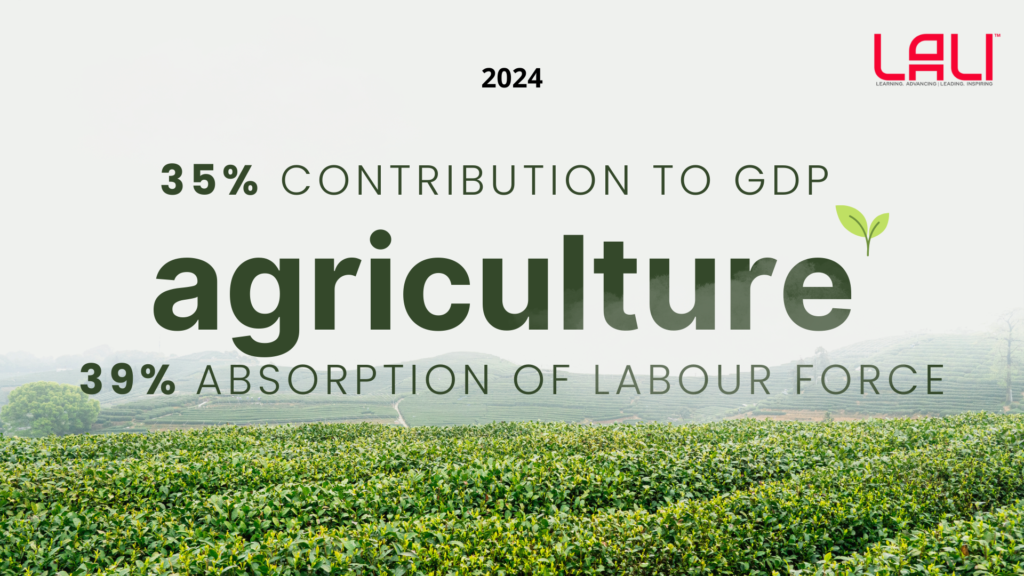
In 2024, agriculture contributed about 35% of Malawi’s Gross Domestic Product (GDP) while employing around 39% of the labour force. This means that a large share of Malawians depend on farming for their livelihoods, yet the sector generates only slightly more than a third of total economic output. This imbalance indicates low labour productivity, where many people are working hard but producing relatively low economic value.
This situation is typical of low-income economies where agriculture is dominated by subsistence farming, limited mechanization, low use of modern inputs, weak irrigation systems, and poor access to markets and finance. While agriculture will always remain important for food security and exports, Malawi cannot rely on it alone to drive rapid income growth.
For meaningful development to occur, productivity in agriculture must increase through investments in irrigation, technology, commercialization, agro-processing, and rural infrastructure. Higher productivity would allow fewer people to produce more, freeing labour to move into other sectors of the economy.
Industry: Small Sector, Big Opportunity
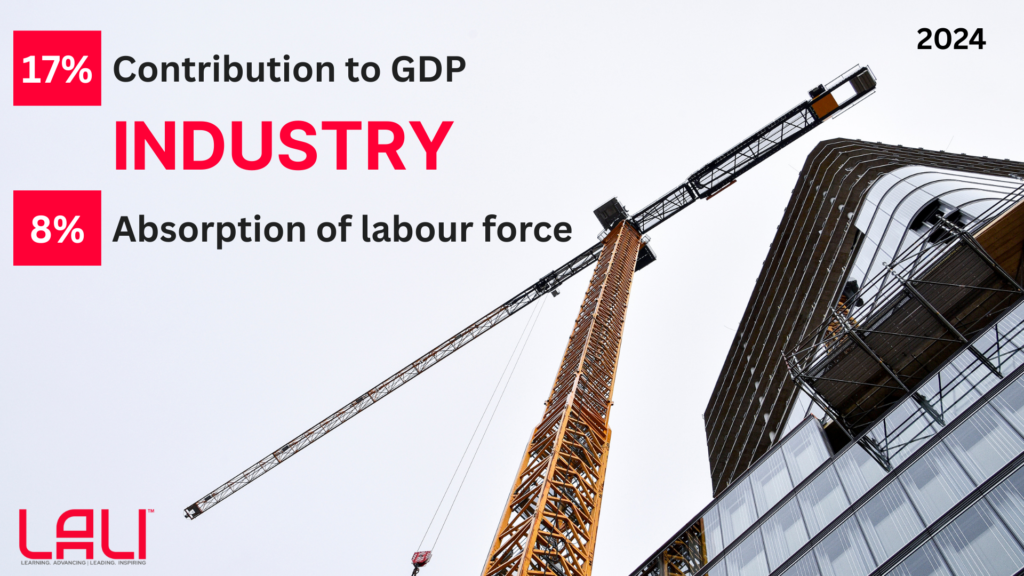
The industrial sector contributed about 17% of GDP in 2024 but employed only 8% of the labour force. This shows that industry in Malawi is far more productive per worker than agriculture. Industrial activities are generally more capital-intensive and technology-driven, allowing each worker to generate higher economic output.
Expanding industry is therefore critical for Malawi’s structural transformation. Growth in manufacturing, mining, construction, and value-addition industries can create better-paying jobs, strengthen exports, reduce reliance on imports, and stimulate linkages with agriculture through agro-processing and input supply.
However, industrial expansion will not happen automatically. It requires reliable energy supply, transport infrastructure, access to finance, skilled labour, and supportive industrial policies. Investments in industrial parks, skills training, and local value chains can help Malawi move from exporting raw materials to producing higher-value finished goods.
Services: Many Jobs, But Mostly Low Income

Services remain the largest employer in Malawi, accounting for about 53% of employment and contributing around 48% of GDP. This aligns with MW2063’s focus on job creation and inclusive growth. However, much of the services sector is informal, with many people engaged in small-scale trading, transport, and personal services that generate low and unstable incomes.
While services have strong potential to drive growth, especially through finance, ICT, tourism, logistics, and professional services, this potential will only be realized if productivity improves. This requires investment in digital infrastructure, skills development, business formalization, and access to affordable finance, particularly for youth and women-owned enterprises.
A more productive services sector can support both industry and agriculture by improving access to markets, information, and financial services.
The Bigger Picture: Why Structural Transformation Matters
Malawi’s current economic structure reflects an economy in transition, with large productivity gaps between sectors. Development is not only about growing the economy, but about shifting labour and resources from low-productivity activities to higher-productivity ones. This process, known as structural transformation, has been at the heart of every country that has successfully moved from poverty to prosperity.
To achieve the ambitions of MW2063, Malawi must pursue deliberate and coordinated policies that raise productivity in agriculture, expand industrial capacity, and modernize the services sector. This includes aligning investments in infrastructure, education, energy, and technology with private sector development and value-chain growth.
If Malawi can successfully manage this transition, the result will be higher incomes, better jobs, stronger exports, and a more resilient economy that is no longer overly dependent on subsistence farming, but driven by innovation, industry, and competitive services.
Leave a Reply